
We know there’s a big gap between what people say and what they do. As people make most of their decisions unconsciously, they’re often unaware of their everyday choices. This can make it difficult to express needs or desires (if you think people know what they need, watch this (Dutch) video from 1999 in which people are asked whether they think they need a mobile phone).
When evaluating the user experience of existing products or services, this means we focus on observing behaviour rather than listening to what participants have to say. But for designers who want to involve users in the early stages of the design process, the discrepancy between what people say and do can cause problems. How do you find out what your customers really need or want? What problems are they currently facing? And what solutions would help them? Since simply asking them won’t work, we’ll need a different approach to find the answers to these questions.
Mapping your users’ context
Context mapping is a method for designing solutions that fit into people’s everyday lives. This approach, developed at Delft University of Technology, focuses on understanding needs, wishes, motivations and experiences. It is a way of gathering insights into the daily use of products and services within the user’s context. It can be used to design new solutions or to improve existing products or services.
The approach combines various research methods. The diagram below illustrates a number of these methods and how they can be used to access different levels of knowledge:
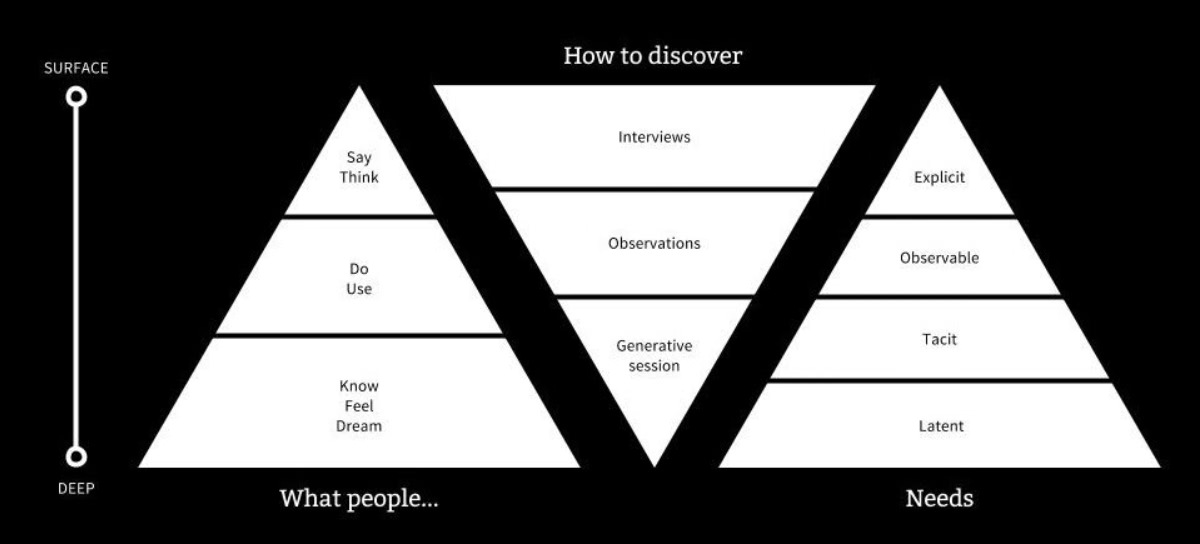
Generative sessions
We recently collaborated with Utrecht University of Applied Sciences. The organisation was planning to redesign its (mobile) website, and we helped them kick-start this project by gathering relevant user insights.
We wanted to understand which factors influence the process of choosing an educational programme. What is going on in these people’s lives at the moment they have to make this choice? How do they decide which university suits them best? Which people and what events influence these decisions? Questions such as these needed answering in order to determine how the university’s website might eventually play a role in this process.
To find these answers, we conducted a generative session, a powerful context-mapping technique. We invited a number of members from the target group: people who are planning to enrol on an educational programme in the near future. By providing the participants with a series of hands-on exercises, we were able to identify all kinds of latent needs and desires. These insights would later form the basis for the redesign.
The timeline exercise
To begin with, participants were asked to plot all the key moments relating to choosing an educational programme on a timeline. What were the important steps or decisions? What factors played a role in this process? The participants all mapped out their own personal journey, from the orientation phase to the moment they had actually enrolled on a programme.
To help the participants along the way, we provided them with stickers, icons and keywords that they could add to their timeline. Some of these were simply random pictures or words, whilst others were based on our own initial assumptions. The participants were free to use this material in whatever way they wished to express themselves.
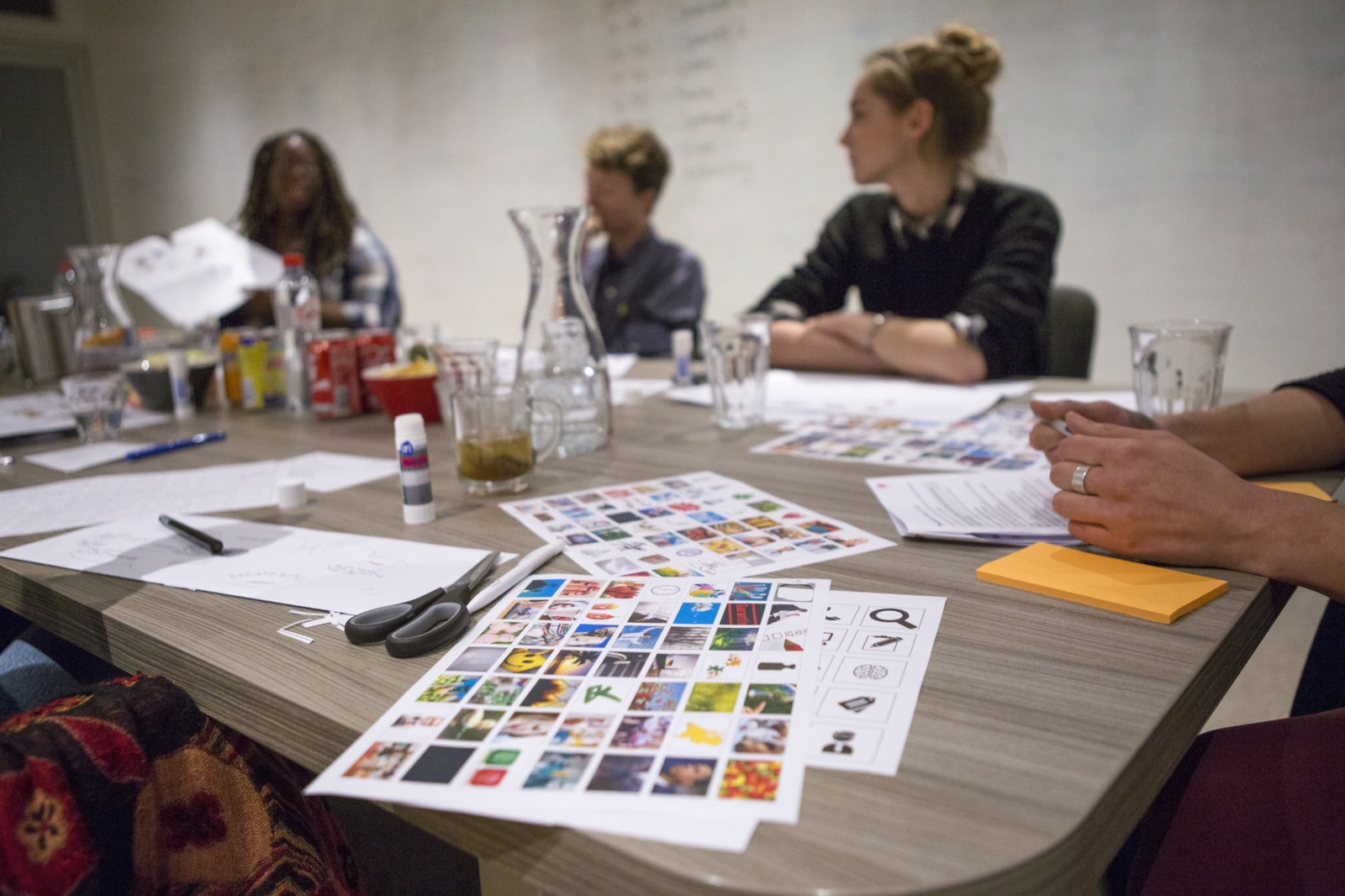
The exercise encouraged the participants to think associatively and helped them to recall relevant memories. This paved the way for the second part of the session, during which they were asked to explain their creations to the group and the moderator. In another room, the university’s project team closely monitored the session via a live stream.
The browser exercise
In the next exercise, the participants were asked to create their own university website on a blank sheet of paper. They could write, draw or use some ready-made components to create their own ideal web page. What sort of information would they expect or hope to see first?
This task focused primarily on prioritisation, rather than on how the website would actually need to be designed. Afterwards, the participants were again asked to tell the rest of the group about what they had created.
Get to know your target audience
A generative session isn’t about the timeline the participants create or the type of websites they design. It’s about the experiences participants share during the explanation phase, providing you with valuable insights into their personal lives.
This data provides excellent input for customer journey maps, design guidelines and user stories. What you learn about your customers will even extend beyond the use of digital products. Getting to know them can reveal new ideas and business opportunities for your organisation.
Why use this approach?
By understanding the context, you can identify desires and needs relevant to your product that you wouldn’t have uncovered simply by asking your customers. It provides you with input for all kinds of deliverables and can help you steer the design and development of your website in the right direction.
Having your participants carry out a series of exercises, rather than simply asking them a number of questions, has many advantages. It puts the participants in the driver’s seat, enabling them to steer the conversation towards their area of expertise: their own experiences.
People are motivated by autonomy. By asking them to explain their own creations and talk about their point of view, they are more likely to open up and share experiences and emotions. Actively doing things in a group brings people closer together, increasing their level of engagement. Also, making something is simply much more fun than being interviewed.
Combining qualitative and quantitative data
Bear in mind that the input you gather from a generative session does not tell you anything about the quantity or importance of the issues, needs, desires or problems you encounter. It might therefore be a good idea to combine it with a quantitative approach, such as an online survey in which you quantify and prioritise the needs you have identified. In this way, you’ll be able to consolidate the insights you’ve derived from the generative session.
Authors
-

-
