
More and more organisations are putting the customer at the heart of everything they do. Not only in the development of their digital services and products, but also in their long-term vision. They conduct research and design based on customer insights. That’s a great step. But it doesn’t stop there. Truly putting your customer at the centre means constantly keeping your finger on the pulse. Never losing sight of them.
In other words: you need to measure customer success. UX & CX metrics help you do just that. They show whether you’re heading in the right direction, and whether you’re actually making your customers a little happier every day. If so, you’ve got a great success to celebrate. And if that’s not the case, you can change course in good time.
In this article, we’ll briefly walk you through the importance of measuring customer success, and how you can go about it in broad terms.
Why is measuring customer success so important?
You make adjustments to your product or service every day. You refine it and develop new concepts. By measuring, you can find out whether those adjustments are having the desired effect. Do they make your customers happier? Do they help them more? Do they deliver better results?
Here are the key benefits of measuring customer success:
- You give your customers a voice.
- You find out whether your changes are having the desired effect.
- It helps you keep your organisation continuously informed of progress in customer success.
- It enables you to compare products and services with one another.
Choose your metrics carefully
There are countless metrics you can use to monitor customer experiences, such as the Net Promoter Score (NPS), Goal Completion Rate (GCR) and Customer Effort Score (CES).
Faced with this sea of possible metrics, organisations often end up measuring too much. And they don’t know exactly why they’re measuring what they’re measuring. They feel that everything is important. That nothing should be left out. You might recognise this: a dashboard full of numbers flying at you from all sides. But what exactly do they mean? What are we supposed to do with them? All those metrics can be quite overwhelming.
You might recognise this: a dashboard full of numbers flying at you from all sides. But what exactly do they mean? What are we supposed to do with them? All those metrics can be quite overwhelming.
You share what you measure. So if you’re not measuring the right things, or if you’re measuring just for the sake of it – what exactly are you sharing? Carefully chosen metrics help you move in the right direction. To measure the things that actually make a difference.
You share what you measure.
3 levels of metrics: strategic, tactical and operational
The basis of good metrics is very simple: as an organisation, you need to determine what your goals are and what your definition of customer success is. You can then identify the right metrics to measure these and systematically monitor whether you’re heading in the right direction.
To make your customers happier, we believe you should measure their experience at three levels: strategic, tactical and practical.
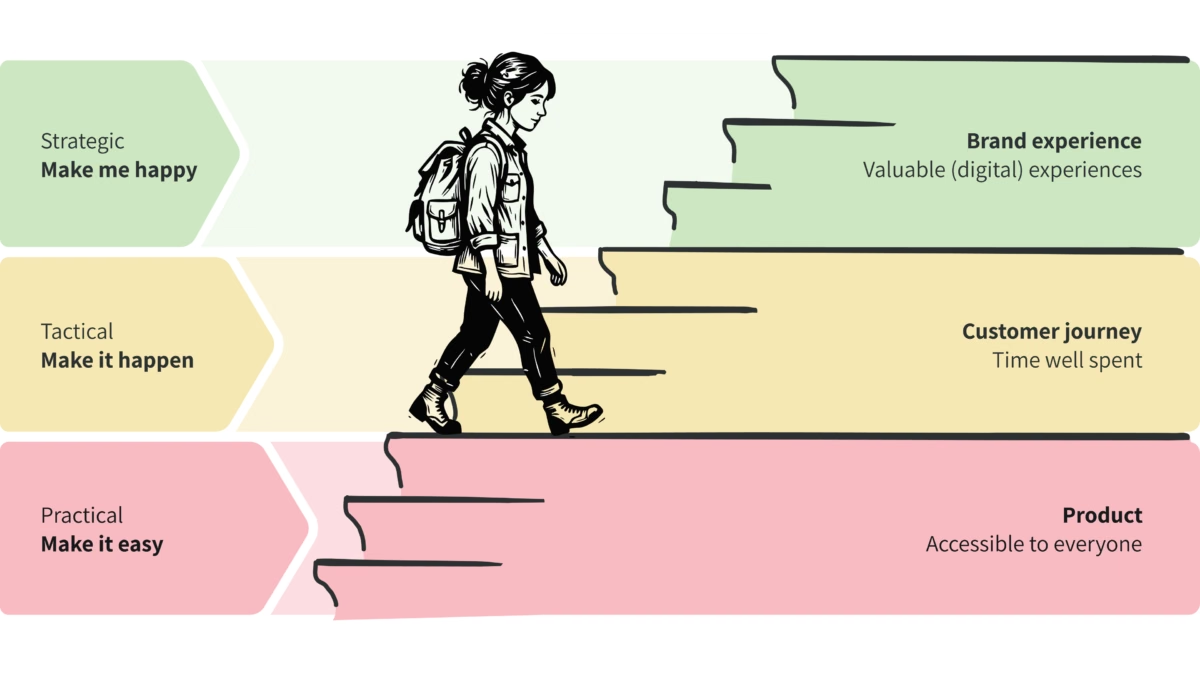
1. Strategic
This is primarily about the brand experience. How do you make an end user truly happy? Are you meeting their underlying needs? Here, for example, you measure customer perception, brand loyalty and emotional connection.
2. Tactical
At the tactical level, you look at the customer journey experience. You compare different products against one another in terms of satisfaction, for example. A metric such as the Net Promoter Score (NPS) can be very helpful here.
3. Practical
Here, you’re focusing much more on the product or feature level. You measure the experience of a specific interaction, such as signing up for a newsletter or placing an order. Metrics such as the Customer Effort Score (CES) or the Goal Completion Rate (GCR) are well suited to this.
We can help you measure customer success
Of course, it’s fairly straightforward to explain the concept behind UX & CX metrics – the theory isn’t that difficult. Putting it into practice is a completely different story. If you need help applying metrics effectively within your own organisation, we’d be happy to assist.
Our strategists will work with you to define exactly what customer success means. We’ll propose a set of metrics. And we’ll then help you implement them. So that it really works, so that you can build on your new metrics and make your customers even happier.

Want to chat about customer success?
Anne van der Veen — Lead CX Strategie & Organisatie
Send message via LinkedIn anne.vanderveen@valsplat.nlAuthors
-

-
