
Having constant access to the internet is brilliant
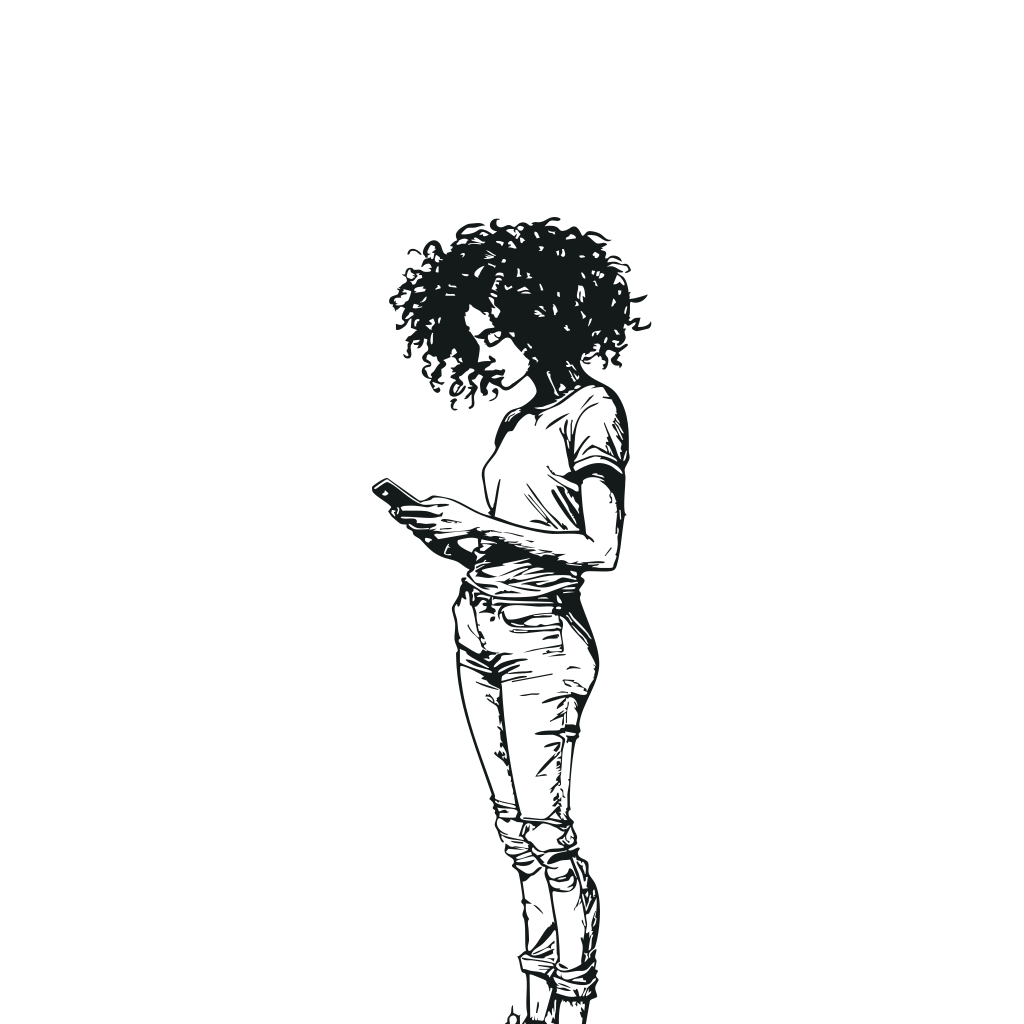
A whole world of information and entertainment is available whenever we want it. At the same time, it’s tricky to manage it properly. If you take your eye off the ball for a moment, you can easily find yourself watching or scrolling away for a couple of hours without giving it much thought. We tell our children not to do that. But let’s be honest: are we any better ourselves? We always have our phones to hand. When a message comes in, we want to reply straight away. We quickly look something up, even at times when it’s not really appropriate.
Much of what we do in the online world is like fast food. It feels good at the time, but afterwards we ask ourselves: was this really necessary? After hours of scrolling or binge-watching, we’re generally not happy with the time we’ve wasted. And ultimately, addictive digital products or services don’t make us any happier either. It makes sense: online, we’re inundated with short-term rewards. These contribute nothing to what gives us fulfilment as human beings in the long term: building relationships, learning something new, becoming good at something, reflecting more deeply on matters.
‘Then don’t do it,’ you might say. ‘Put that phone away, close that laptop.’ But unfortunately, it’s not that simple. Many online services and products are deliberately designed to be addictive. Persuasion techniques and insights from behavioural science are used to siphon off as much of our time, money and attention as possible. As creators in the digital world, we believe we need to do something about this. We must take better care of the physical and mental health of users of digital technology.
Wondering how you can earn genuine attention?
We design digital solutions that treat attention in a healthy way: in a way that is valuable, respectful and good for people. That’s how you build lasting relationships.
Unhealthy use of technology has real-life consequences
As we said: it’s great to have constant access to the internet. But we’ve lost our balance. We notice this in ourselves and we see it all around us. Our unhealthy relationship with digital technology is having a major impact on very fundamental aspects of our lives:
- We’re dissatisfied: online, we’re presented with a perfect world, partly thanks to others’ beautiful photos. This affects our own mental state – after all, you’re never having as much fun as all your friends’ experiences combined. That can lead to dissatisfaction. Or worse: to depression and anxiety disorders. We see it happening to our children: on TikTok and Snapchat, they’re constantly checking where their friends are, which leaves them feeling as though they’re always missing out. And then there’s the infinite scroll: the constant suggestion to watch that next video too. There’s always more to see. More to experience. And as a result, you enjoy the real world around you less.
- We feel insecure: in the digital world, we’re constantly given a reward, an instant reward. Much more often than in the real world. At school, children learn maths and language using digital tools. Every time they complete a small task correctly, they receive a digital pat on the back, a reward, a celebratory jingle. The whole idea of working on an assignment, investing several days in it and only then finding out whether they’ve done it right, has all but disappeared. Children have become so accustomed to constant validation and reward that they are becoming more insecure in real life. Keeping yourself busy, rewarding yourself and doing things out of intrinsic motivation – this is becoming increasingly uncommon and, as a result, more difficult.
- We are less connected: although we are more connected to one another through all sorts of channels, the bottom line is that we are less connected to one another. Loneliness is on the rise. Relationships are becoming more superficial. This is not only because our interactions are now largely digital; it’s also because, even when we’re physically together, we’re constantly preoccupied with the online world. Our phones are always on the table. We’re distracted by a text message or a notification. Or we reflexively reach for our phones to check whether we’ve received another message or email. That constant distraction is a hindrance to deep conversations and genuine connection.
- It’s hard to concentrate: our attention span is getting shorter and shorter. We get distracted more quickly, pick up our phones without thinking and start scrolling. This comes at the expense of focus and deep concentration – and that is precisely what we need to get better at something, to learn something new, to build something of value. The ability to sustain that is gradually disappearing. We’re losing it. This is partly down to how social media, games and other digital products have ‘trained’ us: we’re used to getting a new dopamine hit every few minutes.
- Spontaneity is disappearing: technology is taking a lot of spontaneity out of life. We can look everything up, so that’s exactly what we do. We hardly make any decisions anymore without doing some online research. We want to check everything, know everything. We never have to wonder about anything for very long; we never have to get lost anymore. That’s nice sometimes, but we also lose something in the process. It’s good not to know something sometimes, to be bored for a while. It helps you to look at the world around you in a different way. We’re very happy with technology, but we do need to stay vigilant. Because if we don’t, it will be at the expense of something very fundamental: our happiness in life.
If you care about your customers, you look after them properly
If we want to tackle the challenges surrounding the unhealthy use of digital technology, we need regulation. Legislation that compels companies to treat the users of their products better. But as creators in the digital world, we don’t have to wait for that. We can do something right now – however small-scale it may be. If you care about your users, there are a number of things you simply do and don’t do. For example, you don’t demand an unnecessary amount of their time and attention. You help them to use your service or product in a healthier way. That’s in your own best interests: the more superficial or shallow the relationship with your users is, the less it amounts to and the greater the chance that your product or service won’t survive. Helping your users maintain a healthy relationship with technology isn’t just to their benefit – it contributes just as much to the health of your organisation.
Wondering how you can earn genuine attention?
We design digital solutions that treat attention in a healthy way: in a way that is valuable, respectful and good for people. That’s how you build lasting relationships.



A human standard in the digital world

Will you be our next impact case?
Does your challenge align with our mission? Let us know – there might be a great opportunity for collaboration.

It’s nice to meet you
Nils van den Broek — Founder
Send message via LinkedIn Schedule a meeting nils@valsplat.nl