
Making conscious choices isn’t always easy
How do you live responsibly? When is something sustainable? What is healthy and what isn’t? These are questions that aren’t always easy to answer. We struggle with them ourselves in our daily lives, especially when faced with temptations or conflicting information. We know we need to change our behaviour, but it can sometimes be difficult to make that change in a world that’s all about convenience. Technology can give us a nudge in the right direction. It can help us make healthier and more sustainable choices. And it can help us better understand the consequences of those choices.
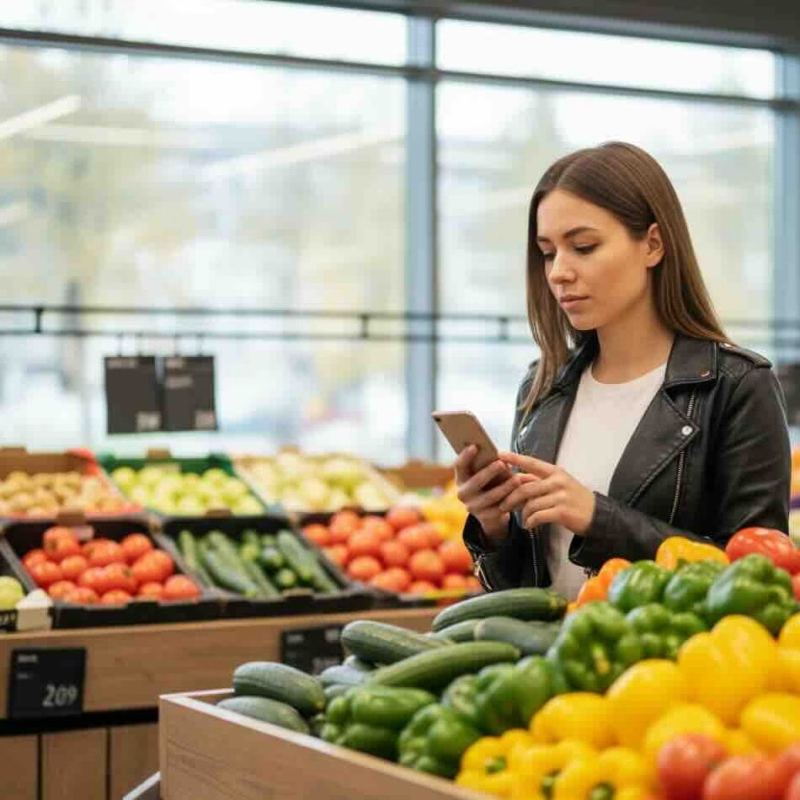
Twenty years ago, when you walked through the supermarket, you bought your groceries based on the limited information on the label. We had to go to great lengths to work out what was good for us and what wasn’t. Now we just grab our phone and have a world of information at our fingertips. Information about ingredients, health risks and benefits. If you have an allergy, you can easily look up what you can and can’t eat. A few clicks and you’ve got your answer. Or, even easier: just scan it and you’ll know. Your supermarket could even alert you if you scan a product containing an ingredient you shouldn’t eat or that doesn’t fit your diet.
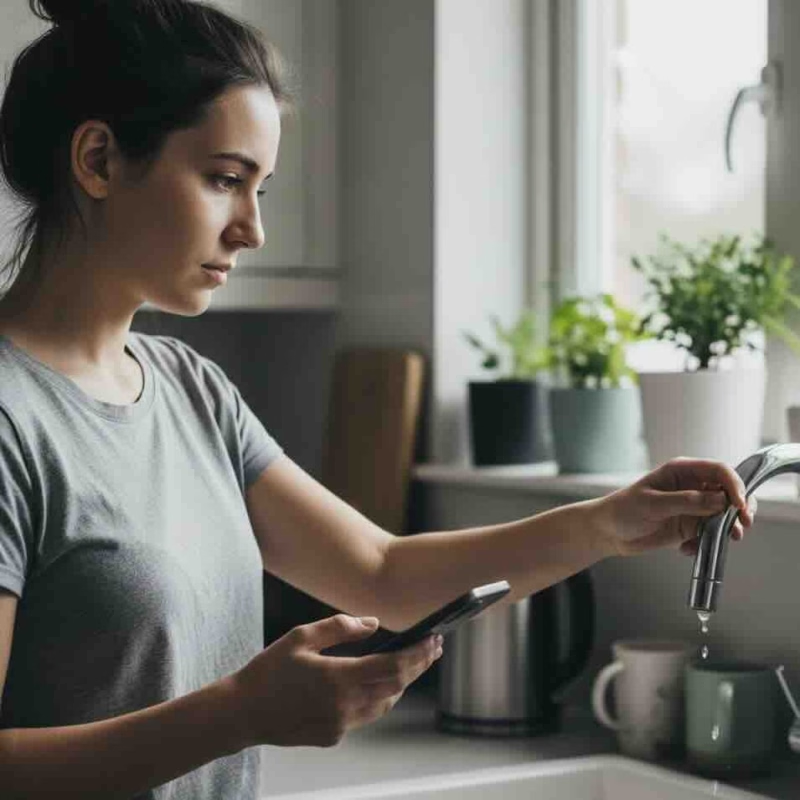

Thanks to digital technology, there is much more knowledge available. Companies can use it to provide relevant information at the right time. To alert us. To suggest sustainable alternatives. Such as a short receipt instead of a long one after self-scanning your shopping – that saves paper. Or choosing a delivery time and location when you order a parcel online, so the delivery driver doesn’t end up at your door for nothing. Sometimes it’s even possible to tick a box to say you don’t want an outer box. Let’s do away with that unnecessary packaging. These may be small steps, but they’re certainly a step in the right direction.
Shall we make it easy to choose sustainable options?
We translate sustainability goals into digital products and services that have an immediate impact.
Despite all the opportunities to help people make sustainable choices, we unfortunately see that many companies all too often do the opposite. They are closed and opaque. Far from inspiring us to make better choices, they use technology to learn about our behaviour, only to exploit it to their own advantage. In recent years, a great deal of knowledge has been gained in the online world about the large-scale application of influence techniques. We know exactly how to steer people towards a specific product. How to trigger certain behaviours. We employ tricks from the behavioural sciences. And in this way, we guide people towards the product they are most likely to buy, rather than towards the healthiest or most sustainable choice. What’s more, technology has made unhealthy and unsustainable choices much easier to access. On Alibaba and Temu, you can have something flown in from China with just a few clicks. Technology has accelerated the fast-paced economy and excessive consumption.
We have some righting to do. And time is running out. We all have a role to play: designers, developers, marketers, leaders – everyone working on digital products and services. That role starts in our day-to-day work. It’s about the choices we make, the way we design, and how we use technology to build a more sustainable future. Every decision, big or small, has an impact on the world around us. By taking action now, together we can bring about the change that is needed.
Take a more ethical stance more often
We cannot expect consumers to make responsible choices on their own. People are far too easily tempted and influenced for that. Just imagine: when you’re in the supermarket or at the checkout of an online shop, you don’t think: where does this product come from? What’s in it? You’re hungry right now; you want to buy the product right now. As designers, we need to take that into account. We must use our talent to help people make the right choices.
Furthermore, it’s up to us – the designers and developers of digital technology – to raise awareness within the organisations we work for. Are we on the right track here? Could a small adjustment make things just that bit better? Digital technology has opened up so many more possibilities. We can track the entire supply chain; we know what goes into products and how much CO₂ is emitted during the manufacturing process. Let’s use that information. Not just for your corporate sustainability report, but also to inform users effectively. It would, of course, be ideal if providing this sort of information were made mandatory by the authorities. But you can already start doing so of your own accord.
We should learn to use the toolkit we’ve developed over the past twenty years in the worlds of marketing and design in a responsible way. We should apply principles of persuasion to guide people towards healthier, better choices, as they might not do so of their own accord. This is not only morally right; it is also a sustainable way of doing business: what is good for your customers and the world around you in the long term is also good for your organisation in the long term.
The challenges we’ve outlined are all significant. Regulation and systemic change are needed, and there are large companies that are having a negative impact. But that’s no reason to do nothing. We don’t have to solve all these challenges at once. The main question is: where can we – whether in small or large ways – take steps forward? We can always do something, because we mustn’t forget that small things can have a big impact.
Shall we make it easy to choose sustainable options?
We translate sustainability goals into digital products and services that have an immediate impact.
A human standard in the digital world




If it moves us, we're in
A few times a year, we offer our expertise and creativity on a pro bono basis for projects that resonate with us and where we can add value.


Will you be our next impact case?
Does your challenge align with our mission? Let us know – there might be a great opportunity for collaboration.

It’s nice to meet you
Nils van den Broek — Founder
Send message via LinkedIn Schedule a meeting nils@valsplat.nl