
When the decision was made to create a coronavirus app, the Ministry of Health, Welfare and Sport (VWS) put together a development team. This team comprised developers, designers, researchers and other experts. A number of Valsplatters were asked to join the team as UX researchers. It ultimately turned out to be a valuable social project of which we are proud.
Challenge
Apps are often designed for a specific target audience. That wasn’t the case with CoronaMelder: the app is for everyone in the Netherlands. And the Dutch are demanding. We expect CoronaMelder to alert us if we’ve been at risk of infection, but at the same time we have a strong need for privacy. In short: creating an app that works and that people are happy with was quite a challenge.
Solution
The COVID-19 Reporter
Together with the entire development team, we went the extra mile to create an app for everyone. And we didn’t do it alone. We listened to feedback. We collaborated with experts both within and outside the government. We made everything we did public via GitHub. We shared designs with professional communities very early on in the process. And we gathered insights on an ongoing basis. Insights from people like you. From people with good eyesight to those with visual impairments. From highly educated people to those with low literacy levels. From digital experts to people who aren’t so tech-savvy.
Because: CoronaMelder can only succeed if it connects with the world of all the people who will use it. If they feel a sense of ownership. If they feel heard. And if they trust that the app solves a problem.
We involved users at every stage
To ensure we didn’t lose sight of the people the app was designed for, a number of our UX researchers were part of the development team. They were there to ask the critical questions: what assumptions are still hidden within the design? How can new ideas best be validated? How can future users be involved? Throughout the project, we presented an improved version of the app to people in the Netherlands on a weekly basis. Not a single pixel or button was designed without testing it with the people it was intended for.
‘During the research, we observe behaviour and listen to the motivation behind the story. We want to find out what works well, what doesn’t work so well, and what people are still unsure about.’
Together with the construction team, we conducted more than 180 interviews with members of the public. We carried out 979 surveys. More than 750 members of the public and experts provided feedback. In short: the users were taken very seriously.
The project in figures
A focus on good accessibility
It is important that the app is accessible to everyone in the Netherlands. And not everyone uses apps in the same way. Take, for example, the millions of people for whom being able to see or read clearly is not a given. This is a very large, diverse group who often navigate websites and apps in a slightly different way. For example, blind and visually impaired people often use screen readers. And for people who struggle with reading, long blocks of text or difficult words can be a stumbling block.
Our researchers spent several sessions in the lab testing the app’s information architecture with blind and visually impaired users. Can they find their way around the app? Or are certain features hidden? The results were impressive. We also held focus group discussions with people with low literacy levels. We went out into the neighbourhood to speak to people with a lower socio-economic status. And we visited people with motor disabilities at home to learn how they use the app.
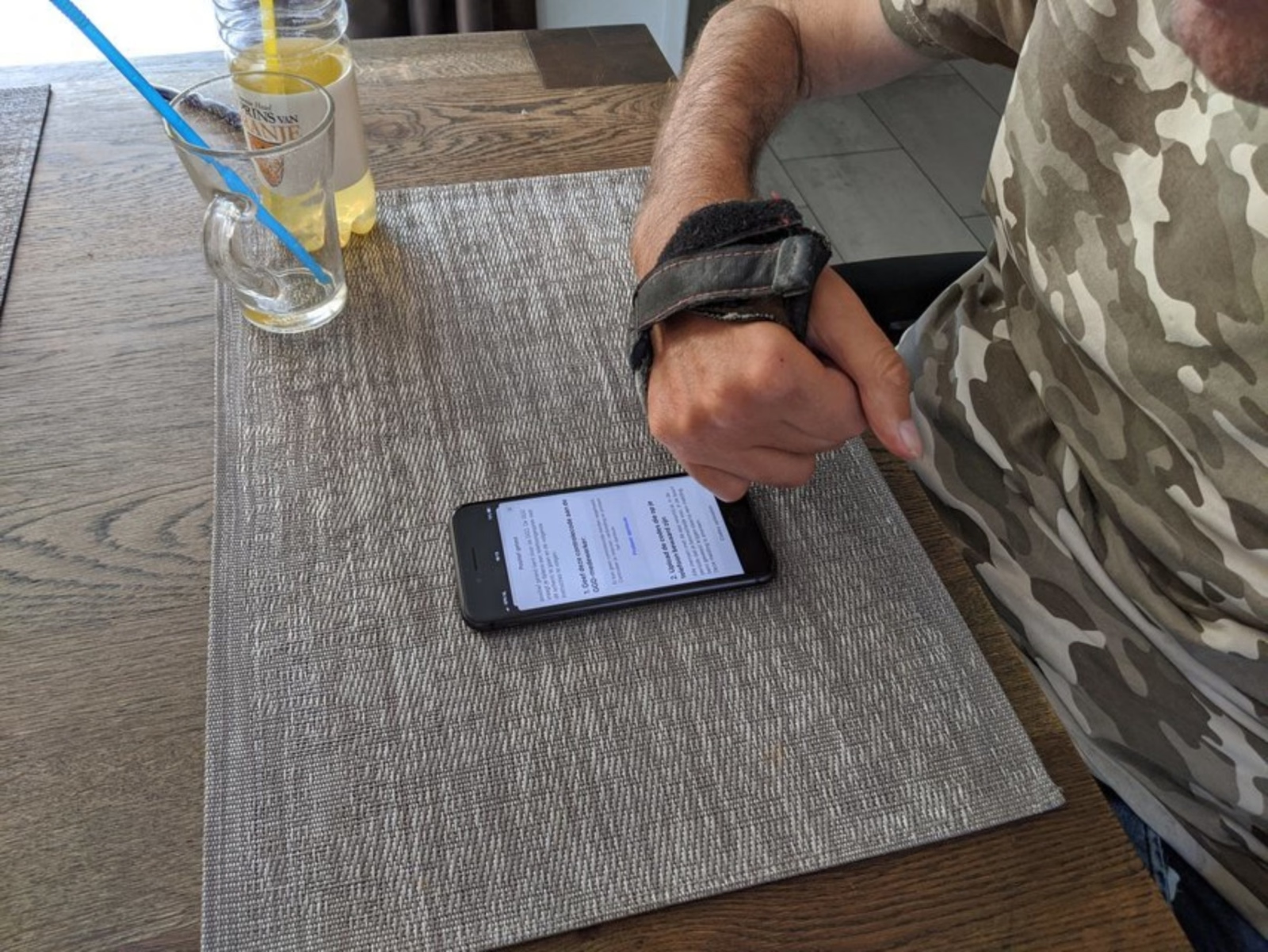
‘If you try really hard to aim carefully, your spasms actually get worse and you’re more likely to click in the wrong place.’
From the big picture to the smallest details
We could write a book about all the insights and design choices made during the development of CoronaMelder.
We explored major themes, such as the role of the GGD and privacy. At the start of the design process, people were concerned that their personal data and location would be shared with others or with the government. Through trial and error, we worked out how best to explain how the app works; how it is possible for the app to know that you have been near someone, without recording who you are or where you have been.
As well as privacy, a host of other misunderstandings and ambiguities were gradually uncovered and resolved — ranging from the app’s usefulness to the number of reports and concerns regarding battery life. As a development team, we went into the finest details to make every aspect of the app as user-friendly and understandable as possible – so that as many people in the Netherlands as possible can and will want to use it.
‘The biggest challenge was striking a balance between all those different design challenges faced by app users and GGD staff. They are all important, but sometimes they are at odds with one another. I’ve never had to work with so many design constraints at once: the impact on the GGD’s processes, speed and accuracy in stopping the virus, ease of use, accessibility and privacy.’
A model for future government projects
What does this approach mean for future digital development within the public sector? As far as we’re concerned, this marks the start of a way of working in which people are increasingly placed at the centre – not just at the end of the process, but from the very first steps right through to the finish line and beyond. So that digital solutions are devised that truly help the Netherlands move forward – solutions that are worthwhile.
With this project, we as a team have shown that things can be done differently. In general, and within the public sector in particular:
- There was no overambitious, rigid requirements document. A set of guiding principles formed the basis.
- We tested, learnt, adapted and retested non-stop.
‘The whole team was able to follow the weekly tests via live streams — this fostered empathy and understanding and contributed enormously to the process.’
- The team designed the entire ‘ecosystem’. So not just the app, but also the supporting systems for the GGD. Just as much attention was paid to user-friendliness and support, as on the front end.
- The government itself put together an in-house team comprising people from both within and outside the public sector, drawing on a wide range of disciplines. They did not – as is usually the case – first draw up a detailed brief and then seek out suppliers to fulfil it. This allowed for course corrections, learning and flexibility.
- The people who will be using the app (members of the public and GGD staff) helped shape it through their input. In short: everything is geared towards serving their interests.
Do you want to reach as many people as possible with your website or app?
Nils van den Broek — Founder

Authors
-

-

-
