
Over the past 75 years, Lotus has designed a great many iconic sports cars. These days, they’re producing more and more electric cars, such as the new Lotus Eletre. The care they put into their cars is matched by the care they put into the experience surrounding them. Take the driver companion app, for example. Before the Lotus Eletre was launched on the European market, they wanted to be absolutely sure that the app was ready too. They wanted to hear what customers thought of it and how they were using it. We were able to help them with that.
What began as a simple UX test gradually became a new way of working for Lotus. Eletre drivers became increasingly involved in the app’s ongoing development. Their voice carried more weight. This resulted in a better product, a better app and happier customers.
In this case study, we show how we helped Lotus adopt a user-centred approach step by step – and what you can learn from it.
3 reasons why Lotus should adopt a user-centred approach
A user-centred approach means always putting your customers first – focusing on their wishes and needs. You talk to them, you listen to them, you get to know them. And based on that, you improve your product or service. Lotus recognised all sorts of benefits in a user-centred approach. Here are three of them:
- It helps with prioritisation
By constantly keeping a close eye on things, Lotus knows exactly what Eletre drivers need, what’s working well, and what could be improved. That helps when setting priorities: what do we build first? What can wait a little longer?
- It provides certainty
Designs are tested before they’re built. That provides much greater certainty. By investing a little extra time upfront (in research), Lotus ensures it doesn’t waste time and money on features that turn out not to work.
- It prevents debate
Insight enables the Lotus team to champion new features that users actually need. With research results in hand, it’s much easier to secure the go-ahead.
With research findings in hand, it’s much easier to gain buy-in.

From a simple test to a user-centred approach
If you want happy and (ultimately) loyal customers, you need to get to know them well. There are all sorts of ways to do this. You can carry out a large-scale survey or a small one. The most important thing is to get started. For Lotus, it began with a UX test, to implement final improvements ahead of the launch of the Eletre. The steps we went through with Lotus illustrate very well how, starting from an initial test like this, you can gradually adopt an increasingly user-centred approach.
Step 1: a UX test
A UX test (user experience test) is a conversation between our researcher and a user of a product. As the Eletre hadn’t been launched yet, we spoke to people who own a high-end electric car. In a relaxed setting, we got them to try out the app. We gave them tasks, asked questions and observed. What works well? Where are the pain points? Do they understand the features? Or do they overlook them?
Behind the scenes, the Lotus team was watching. That’s the big advantage of a UX test: you see your target audience at work. You see how your product is experienced. That broadens your perspective. The output of a UX test is very concrete – you end up with a set of insights and a list of areas for improvement. To make things as easy as possible for Lotus, we immediately designed solutions based on those insights.
In a UX test, you don’t necessarily uncover people’s deeper needs or frustrations, but sometimes you get hints or glimpses. What you hear your customers say raises questions – questions you can explore further in, for example, in-depth interviews.
“We learnt an awful lot from the first test. It was incredibly valuable to see potential customers using our app. All sorts of blind spots became apparent. It immediately left us wanting more.”
Step 2: Getting to know the customers even better
The UX test provided clarity and specific areas for improvement. The app made huge strides following the test. But it also raised questions. Once the first cars had been delivered and the app launched, we were able to delve deeper to get to know your customers even better. How is the app experienced ‘in real life’? How do customers use it in their day-to-day lives? What role does it play?
To learn everything about the customers’ context, we maintained contact via WhatsApp with six Lotus drivers for two weeks. We set them small tasks and asked questions (we call this type of research a ‘diary study’). The Lotus drivers shared their daily experiences via photos, videos, screenshots and audio clips.
By staying in touch with people for longer, we were able to dig deeper. For example, we discovered that business Eletre drivers have specific needs regarding tracking their energy consumption and mileage – features that work very well in the app, but which users found difficult to locate intuitively. During a diary study, insights like these come to light much sooner than in a UX test. Finally, we conducted an in-depth interview with each participant to ask them any remaining questions we had.
By working closely with customers and really taking the time to listen, you can uncover needs and frustrations that remain hidden in the lab or online.

Step 3: design, test, design, test
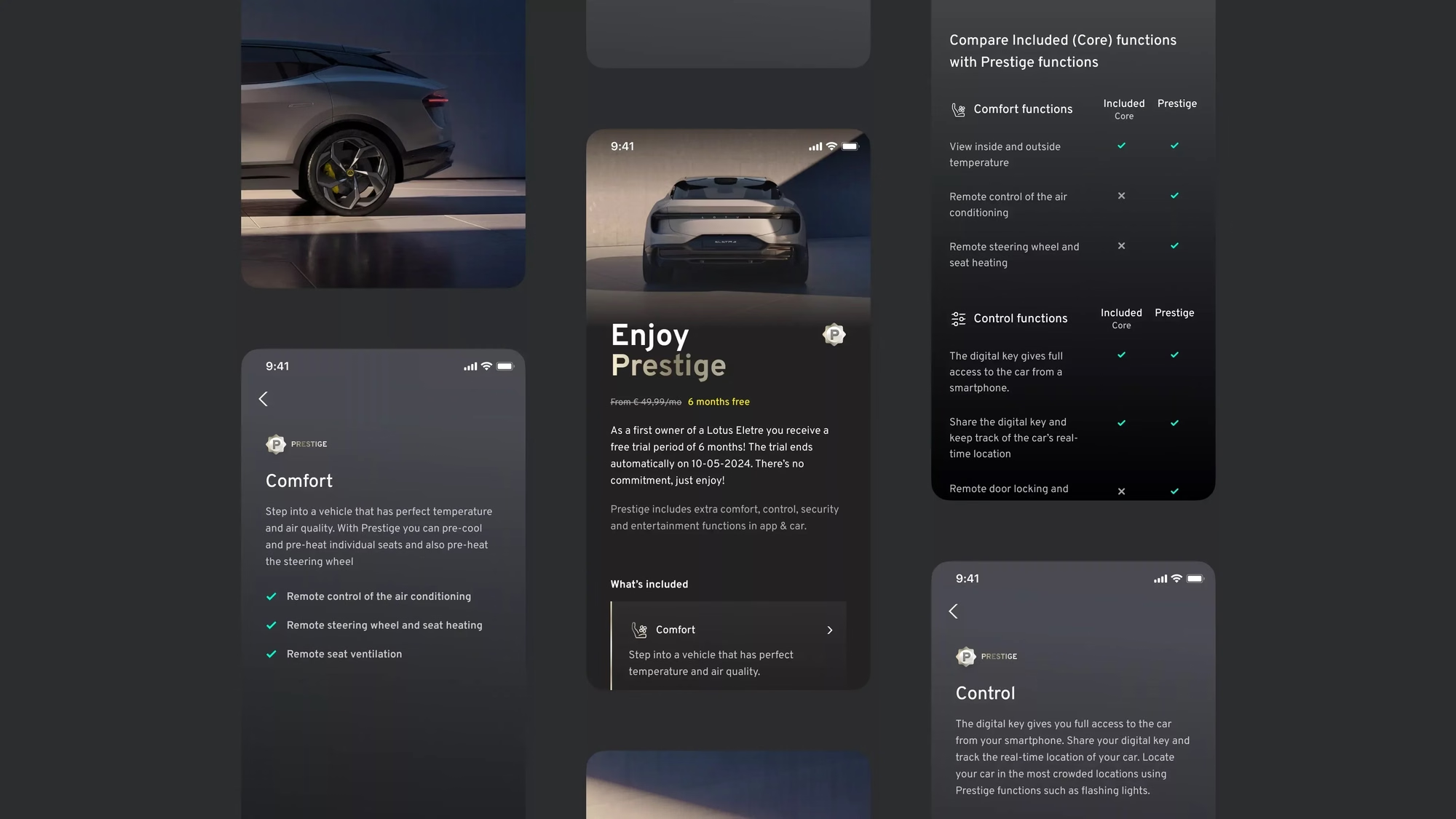
In parallel with the diary study and in-depth interviews, we designed concepts for new features – one doesn’t have to wait for the other. We devised concepts based on the insights we’d already gained. We then carried out UX tests to validate the new designs and refine them further. Design, test, design, test – that’s how you learn more and more about what customers want, and how your product becomes increasingly valuable.
Would you like to carry out research more often, just like Lotus? Here are three arguments to help you get your organisation on board
Perhaps you’ve already decided for yourself that you want to carry out research more often, that you want to work in a more user-centred way. Now you need to get your organisation on board. That can be tricky. That’s why we’ve listed three reasons for you to carry out research not just now and then, but on an ongoing basis:
- If you carry out research more often, you’ll gain better insights
By conducting research regularly, you can make each study more focused. You can delve deeper into a specific topic and therefore learn more.
- Conducting research more frequently is more efficient
Conducting research may sound time-consuming and costly, but in fact it isn’t. By gathering feedback from customers more frequently, you can refine your product as you go along. The moment you realise you’re heading in the wrong direction, you can course-correct, before you’ve invested time and money in an idea that will never work.
- Conducting research more frequently leads to more loyal customers
If you test more often, you’ll speak to a wide variety of people. This gives you an increasingly nuanced picture of your customers and their needs. And that, in turn, enables you to deliver a top-notch experience – one that makes your customers happier and, ultimately, more loyal.
Would you like to adopt a more user-centred approach too?
Nils van den Broek — Founder

Authors
-

-
