
This interview is taken from our book Weg van tech. For the book, we spoke to leaders, scientists, artists, entrepreneurs and ordinary Dutch people about the human standard in the digital world.
About Cybersoek
Four million people in the Netherlands are struggling to navigate the digital world, two hundred thousand of whom live in Amsterdam. Cybersoek, a ‘welcoming neighbourhood hub’ in the Oost district, is trying to change that. Cybersoek offers free digital support to anyone who wants it, says director Karien Sondervan (1983).
Why is a place like Cybersoek needed?
“Around the turn of the century, it became clear that inequality was emerging in relation to digitalisation: some people had access to a computer at home, whilst others did not. That is why Cybersoek was set up twenty years ago as one of four hundred ‘digital playgrounds’: accessible venues in priority neighbourhoods, where, on the initiative of the Ministry of the Interior, residents could engage with ICT in an accessible way. As funding ceased after three years, all these locations and meeting places disappeared. Except for Cybersoek: the then director and the board of the Oost district council recognised the positive impact this place had. When the curtain did threaten to fall in 2018, I was already involved with Cybersoek as a project leader. I stood by and watched as this neighbourhood was set to lose a hidden gem with an important role and a good reputation. During the pandemic, digital self-reliance came back onto the agenda, as it became clear that not everyone could participate online from home. That’s when I became director. I’ve tried to put Cybersoek back on the map and normalise questions about the digital world. Yes, perhaps this is a case of ‘never waste a good crisis’.
Nowadays, being online is no longer something you can choose to do or not. Over the past twenty years, it has become a basic necessity. You need the online world for everything: to access healthcare, education and social contacts; to manage your finances; to find leisure activities; and to communicate with the government. If you can keep up with the digital world and all its changes, you’ll have a real head start. But for many people, that’s not the reality. Digital inequality stems from a lack of financial resources to buy a computer or mobile phone, or from a lack of confidence in using such a device. Yet it is not just an individual problem. We have built systems that are too demanding; technology is advancing faster than we can keep up with. If you’re out of work for a short while, you’ll find it almost impossible to get back on track. That is why digital inequality is a form of social inequality.
“We have built systems that are too demanding; technology is advancing faster than we can keep up with. If you step away from the labour market for a short while, you’ll find it almost impossible to get back into it. That is why digital inequality is a form of social inequality.”
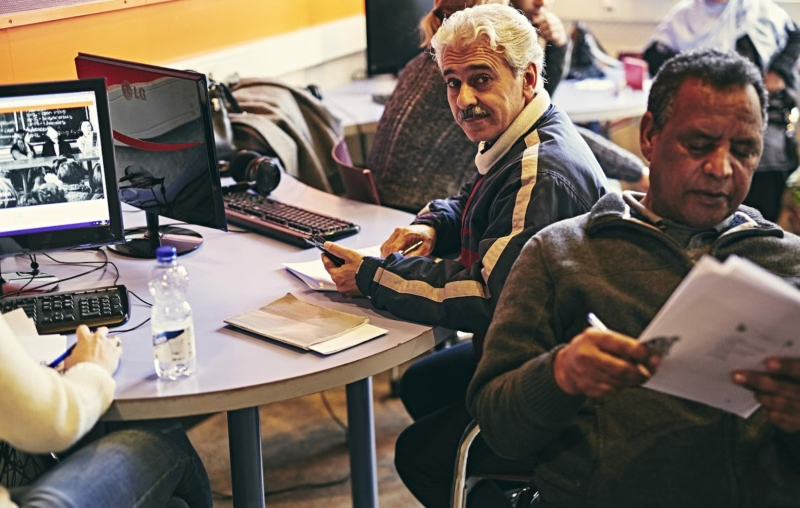
All sorts of local residents who are facing digital challenges come to Cybersoek. These might be older people, but also children who don’t have a laptop for school, or people in their thirties who need to find work online. It is precisely the group entitled to benefits or council discounts who often find it difficult to navigate the digital world to access them.
You sometimes hear people say that digital literacy is the individual’s responsibility. The idea is: take a course and you’ll be able to do it. But it’s not that simple. To get by in the digital world, people need a range of skills. There are those who do understand how to use their works planning system, but don’t know how to use Google Maps. Some know exactly how their hospital’s online system works, but can’t do online banking. At Cybersoek, we offer support and encourage people to keep learning. Because technology is constantly changing.”
It’s not just older people; young people, too, sometimes struggle to keep up in the digital world. Could you explain that?
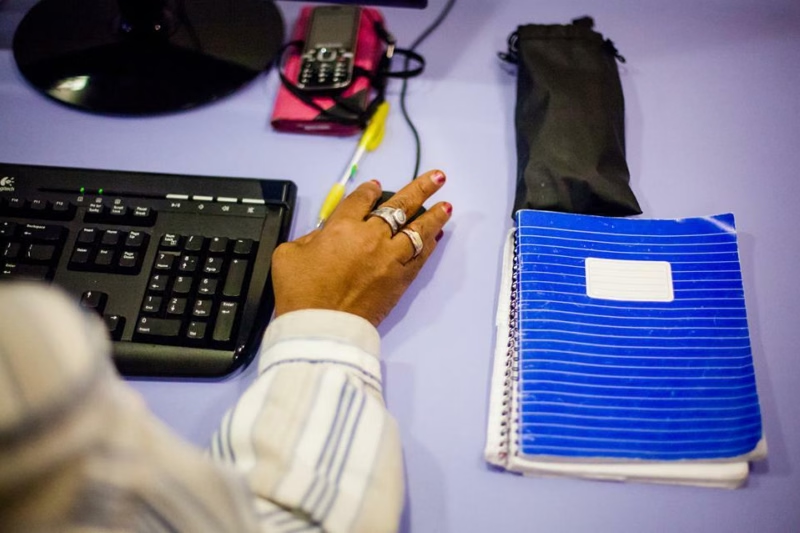
“The idea that we have to wait a generation for digital inequality to be resolved is a major misconception. Inequality is not confined to a single generation. There will always be people who cannot meet the requirements needed to stay connected online. Schools, for example, often use digital platforms to communicate with parents. But some parents don’t know how that works, don’t have 24⁄7 access to the internet or don’t have an up-to-date device. They can’t schedule a 10-minute call, don’t have access to the school newsletter and have little contact with other parents.
“The idea that we have to wait a generation for digital inequality to be resolved is a major misconception.”
A visitor to Cybersoek wanted to help her daughter prepare for a school presentation. She explained that she’d spent hours trying to work out how to use a word processing programme. It all started with the question of which programme was the most user-friendly. Once she and her daughter had written something, the document went missing. Neither of them had any idea where it had been saved. Adding photos also proved tricky. The teacher had allowed them to print out a photo, but the mother didn’t want her daughter to be the only one sticking photos on the blackboard and perhaps being laughed at.
There’s a huge difference among children when it comes to digital confidence and responsible use. Some spend eight hours a day on Snapchat, but don’t know how to hand in a school assignment via Teams. Do children use social media very intuitively, as if they were slaves to technology, or do they understand what they’re part of? That knowledge and awareness depend on whether or not their parents can guide them through the digital world. That is why, as part of the ‘School for Parents’ programme, we offer Dutch language lessons and also teach parents how to help their children grow up safely in the digital world.”
Amongst Cybersoek’s visitors, you often see signs of digital stress. How does that come about?
“When you and I find that something isn’t working, we can see the cause as lying outside ourselves. People who come to us blame themselves when they don’t understand something in the digital world: ‘I can’t do anything either, I’m stupid, I’m missing something I really ought to have,’ they think. For example, they’ve bought a phone, but then it turns out that a particular app can’t be downloaded. They become stressed and angry with themselves, rather than with the system.
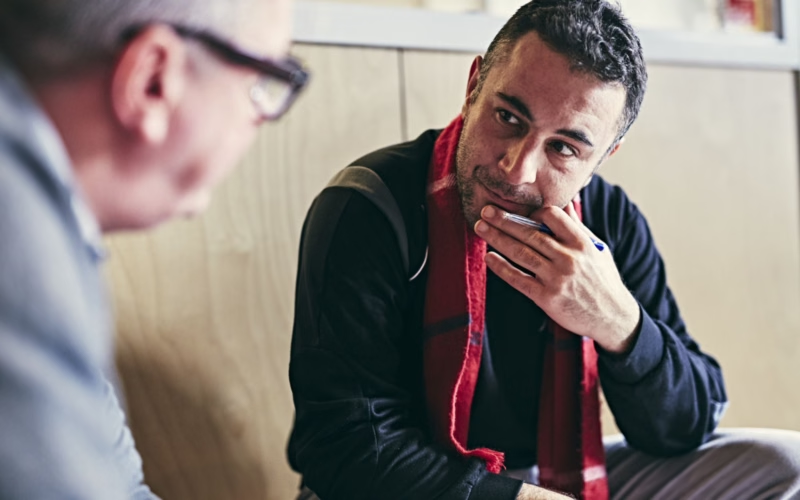
That form of despair is difficult to recognise, because people are good at hiding it. Out of a sense of paralysis, they often have no idea where to start. When we recognise digital stress and ask about it, people usually react with sadness. In the literature and news articles, this group is often portrayed as ‘the vulnerable members of our society’, but I know of no group that is stronger than this one. It takes courage to take that first step at Cybersoek.”
How does Cybersoek help this group of people?
“As well as basic computer skills courses, we also run drop-in sessions for any questions about phones, tablets and social media. We also provide free language lessons, because proficiency in Dutch is inextricably linked to digital literacy. Before I became director in 2019, I was already involved in an empowerment project for women at Cybersoek. We helped them to make their voices heard. There, I realised that simply figuring out what you need – and then being able to formulate a question – is a skill in itself.
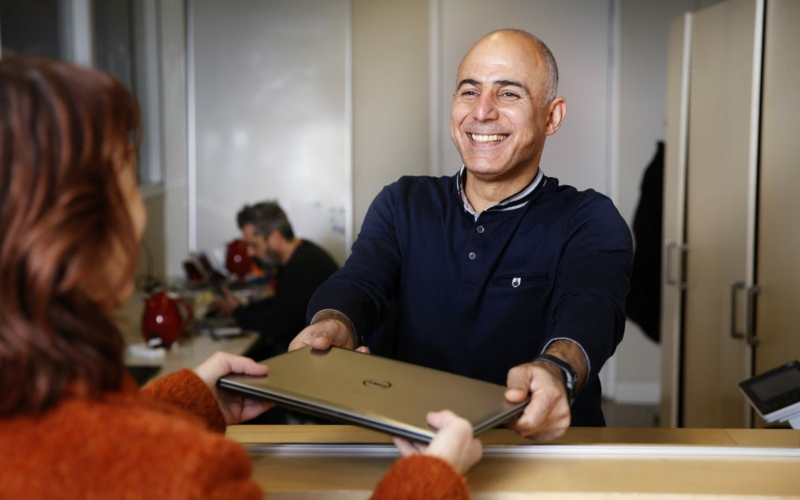
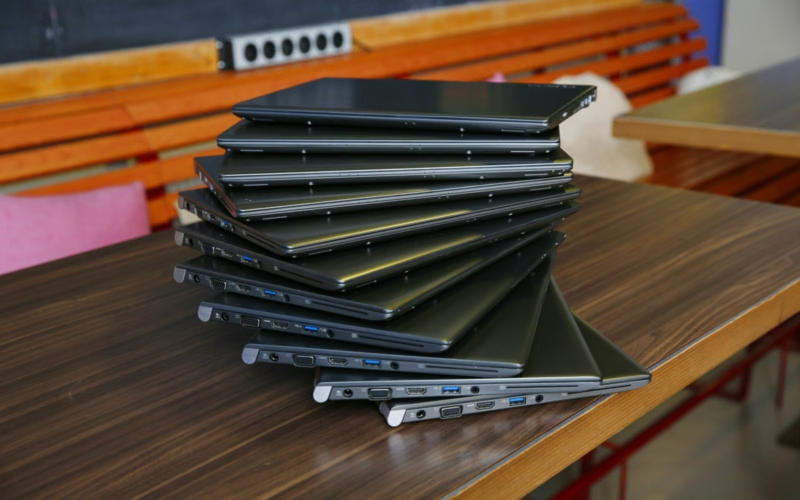
At the Cyberbank, part of Cybersoek, Amsterdammers with a city pass can buy a laptop for 20 euros. These are laptops donated to us by Amsterdam-based companies and the City of Amsterdam. The social enterprise ICT van Morgen refurbishes these devices with young people who are distanced from the labour market. When ‘selling’ these laptops, there is always someone on hand to answer questions straight away. Finally, there is the Cyberhub, which I consider to be Cybersoek’s hub for digital inclusion. This is also how we find our volunteers: local residents or employees of large companies who realise what a parallel world exists in the Netherlands. The volunteers feel a sense of responsibility to build bridges and share their privilege – being at ease in a digital world – with others who struggle to keep up.”
What else is needed to tackle this digital inequality?
“To begin with, the government should recognise that the digital world is not accessible to everyone. It should then do everything in its power to improve that access. Digital inequality is an issue that cuts across all departments. This means it is unclear where responsibility lies and who should take the lead.”
“To begin with, the government should recognise that the digital world is not accessible to everyone.”
Offering free internet would be a great step forward. There are already many cities, such as Barcelona, Vienna, Helsinki and Paris, where this is already happening. If, as a government, you prefer to collect data from citizens digitally, then you must also ensure that people have access to the internet and a device with which to use it. A good example: in Belgium, the social internet scheme came into effect last year. More than half a million low-income Belgians now have access to the internet for up to 19 euros a month. In the Netherlands, market forces have driven prices up to such an extent that the internet has become unaffordable for people living in poverty. Yet the internet is a human right. For many Dutch people, an average internet subscription accounts for 10% of their disposable income. Of course, they can go to the library to get online for free. But that’s not really a realistic option, as many of us are online all day, not just during the library’s opening hours.
Ideally, I’d like to see organisations and companies – such as public authorities, banks and health insurers – provide support themselves to people for whom their digital products don’t work. At the moment, that responsibility is being shifted onto civil society.”
You’ve now been working at Cybersoek for eight years. What are you most proud of?
“I actually cried with pride just the other day. The Oranjefonds supports us with funding, and they wanted to do a feature on our colleague Shady. He came to the Netherlands from Syria and, because his wife was taking a course at Cybersoek, he got involved with us. Now he works here. In conversation with the Oranjefonds, he explained how happy he was to be an integral part of the Cybersoek team. He feels at home and is able to put his talents to good use. How brilliant is it that, as an employer, I can contribute to that feeling? It was a confirmation that work is so essential to shaping who you are. Providing an accessible space must be consistent across the whole organisation: Cybersoek helps Amsterdammers with digital queries, but we’re also here for people looking for a new path into the labour market. As an organisation, we must seize every opportunity to combat inequality – and, with it, digital inequality.”
“As an organisation, we must seize every opportunity to tackle inequality – and, by extension, the digital divide.”
If you were to hand over the reins tomorrow, what advice would you give to your successor?
“The first thing that springs to mind is: devote most of your time to human contact. Don’t fall into the trap of spending too much time sitting at your computer. Put your whole self into it, with your heart, and don’t be afraid to show your vulnerability. Always make sure you’re well-informed, or speak on behalf of the people concerned. As an anthropologist, I’ve learnt that there isn’t just one truth: there are so many different ways of looking at what’s happening in the world. That realisation helps me every single day. We need to connect and meet one another on a level that goes beyond customs and habits. Ultimately, it’s about people, not those computers.”

About Karien
Cybersoek has been campaigning for digital justice since 2001, through support and education. Its aim is a society in which everyone benefits from the advantages that technology can offer. The word ‘soek’ in the name means ‘market’ in Arabic. Cybersoek has its main office in Amsterdam-Oost and meeting places at partner organisations in all other city districts. Karien Sondervan (1983) has been its director since 2019.
Credits
Text: Fidessa van Rietschoten
Photography: Gerritjan Huinink and Cybersoek

Let’s work together to bridge the digital divide
Nils van den Broek — Founder
Send message via LinkedIn Schedule a meeting nils@valsplat.nlMore about our mission
Authors
-

-
