No one deserves the title of ‘Hero’ more than The Includer. And she owes that solely to the fact that she stands up for people with disabilities. Fortunately, her years of dedication have paid off: inclusivity is increasingly becoming the norm, and the WCAG guidelines for digital accessibility are now mandatory in the (semi-)public sectors. According to The Includer, everyone has the right to access. Whatever your disability may be, and whether it’s about access to websites, a festival or society as a whole.
Moreover, the term ‘disabilities’ is broader than you might think. It’s not just about accessibility, but also about inclusivity: how can we create equal opportunities? How can everyone feel heard, seen and respected?
Superpowers
- Sincere and caring: the desire not to exclude anyone stems from the best of intentions.
- An extremely strong sense of justice: The Includer stands up for the rights of everyone with a disability and marginalised groups.
- The Includer is the future: anyone who completely ignores her is also doing themselves a disservice.
- The more people who can use your product or service, the better.
Kryptonite
- Sometimes it’s a bit of a grey area: for example, should you make an app for lease cars accessible to visually impaired people who don’t actually drive?
- Inequality of opportunity often starts within your own team: if your designers are all white university graduates, be very aware of the bias that this entails.
- Accessibility for every individual is a noble but unachievable goal: there’s always going to be someone you leave out.
- Making your service accessible is expensive and time-consuming.
The Includer in practice
The Includer is everywhere. Online, this means that colours, typefaces and fonts comply with WCAG guidelines for people with visual impairments, that websites can be read aloud, and that texts are written at an accessible B1 level. Offline, you’ll see The Includer in a platform for wheelchair users at a festival, a boardwalk on the beach, gender-neutral toilets, and prayer and breastfeeding rooms in offices.
Archenemy
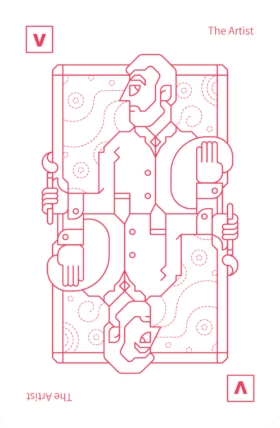
She’s not on friendly terms with The Cashier: accessibility costs money and time, and doesn’t always pay off. And The Artist would rather see her go than come either: WCAG guidelines don’t really result in sexy design, and lead to ‘boring’ texts.
Ally
She gets on a treat with The Idealist: after all, equal rights for everyone are also Sustainable Development Goals.
Summary
The Includer’s goal is clear: she wants everyone, or at least the vast majority of the world, to be able to participate. For your product or service, it’s important to take the WCAG guidelines into account. After all: the more users, the better. Although it’s an illusion to think you can be accessible to everyone.
Would you like to find out more about the Heroes of Value in our workshop?
Request a free set of cards. In our accompanying workshop, you’ll learn how to put the Heroes into practice to improve your product or service.

Want to find out more about the Heroes of Value? Let’s get to know each other!
Nils van den Broek — Founder
Send message via LinkedIn Schedule a meeting nils@valsplat.nl